

The best news from Iowa on health and wellness
Provided by AGP
From Spreadsheets to Smart Systems: How Wisconsin Companies Are Putting AI to Work
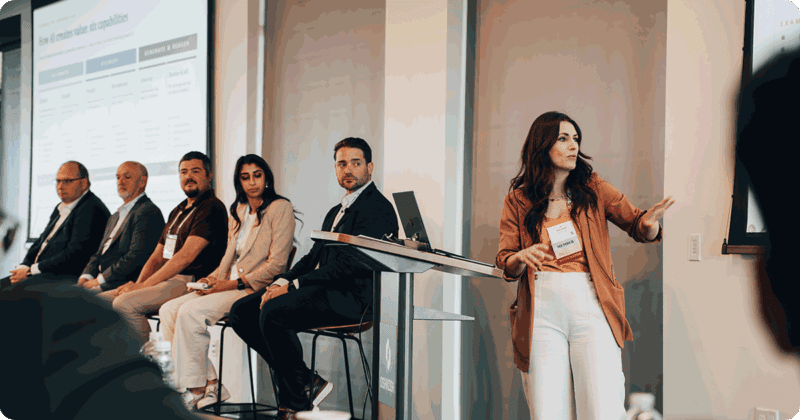
Katie Schmitz, Ziegler Link-age Funds, moderates the Enterprise AI Leadership Plenary Panel at the 2026 Wisconsin Tech Summit in Oshkosh.
From a healthcare software firm in Verona to a dairy and beverage producer in Green Bay—companies across Wisconsin are changing the trajectory of their products and workplaces with artificial intelligence (AI).
Top tech leaders shared how the evolving, powerful tool is changing how work gets done during the Wisconsin Technology Council’s annual Wisconsin Tech Summit in Oshkosh on April 30.
Their accounts reveal a real-world picture of AI adoption: sometimes messy and iterative, but ultimately productive and worthwhile for both businesses and their customers.
“AI succeeds when it’s practical, embedded and trusted—not flashy,” said Jon Hardin, chief technology officer at Cresa, a national commercial real estate firm with an office in Madison.
The brokerage has embedded AI in critical areas including finding properties, negotiating leases, and managing large corporate portfolios. One of its concrete wins is in lease abstraction, the time-consuming task of extracting key dates, costs, and clauses from leases that can run 100 pages.
That process once took two to four hours of outsourced human work. Using AI, it now takes only minutes. AI flags key passages and includes a confidence score on its selections. The AI’s output then undergoes a human review.
The firm also built an AI portal that allows brokers to create an eight- to ten-page branded report on local market conditions using public data and proprietary market intelligence.
Cresa also has a pilot group of about 160 people who represent a cross-section of the firm who are empowered to share AI-related ideas with their IT team that could be useful company-wide.
But Hardin also noted AI can engender fear among users. “In general, there is a lot of excitement with AI where people want to try the tools, but sometimes people do have to be dragged kicking and screaming a little bit to use the applications,” he said. “Then they’ll eventually learn that those things will make their lives better.”
At Alliant Energy, an Iowa-based utility with a large Wisconsin service area, Josh Murray said AI is used for everything from generating presentation slides to maintaining wind turbines 200 feet off the ground.
Murray, assistant vice president of AI, innovation, and emerging technology, said AI predicts when components such as wind turbine generators, gearboxes, and bearings will fail. By grouping repairs and replacements, Murray estimated the utility has saved millions in costs.
Generative AI is also helping the utility. At a recent meeting, a vendor was pitching software that would allow Alliant employees to get pre-job safety briefings in the field on their cell phones.
During the hourlong meeting, Murray started “vibe coding”—asking generative AI to create a similar iPhone app. “At the end of that hour, I had something that was decent … and I don’t have a software engineering background,” Murray said, adding that they saved $300,000 on the vendor’s subscription.
Green Bay’s Schreiber Foods, a customer-brand leader in cream cheese, natural cheese, processed cheese, beverages, and yogurt, is using AI to manage complex global supply chains to produce and get perishable products to market efficiently.
Blair Tritt, vice president of corporate ventures and digital labs, said the company has converted decades of supply chain management done on spreadsheets to algorithms and AI.
“It is extremely complex for the amount of risk that you need to take and buy those materials and how you formulate them according to FDA guidelines and government standards and how you price to all sorts of levels of customers,” Tritt said. “You need a competitive intelligence layer that sits on top of all of that to make better decisions for your business and drive profitability.”
Schreiber has also used the tool to automate 95% of the processing of thousands of invoices previously done manually.
At Verona-based Epic, which provides electronic health records to hospitals, health systems, and health care providers, AI is helping to deliver better medical care by freeing up physicians’ schedules and getting patients more timely care.
Carissa Kathuria, research and development group lead at Epic, said AI is helping physicians who use Epic’s products work more efficiently.
“We know from data that most outpatient doctors spend 2.7 minutes revieing their patients’ chart for an appointment,” she said. “AI can make sure that those minutes that your doctor spends reviewing the chart will include the most important information so that they can make the best care decision.”
Epic has also deployed an AI scheduling agent that lets patients book and reschedule appointments, saving health systems hundreds of staff hours in their call centers.
Epic is also using AI to help patients access prescription drugs faster and more affordably. Sometimes a doctor will prescribe medication that requires an insurance company review, requiring answering a battery of questions over the need for the drug.
“We created a tool that looks at the patient’s chart and drafts responses to those questions,” she said. “We saw a 19-hour reduction in turnaround time, which means that patients are getting the care they need sooner.”
At Sub-Zero Group, a Fitchburg-based manufacturer of luxury appliances, CIO Jody McDonough said AI is playing a role in the future of its workforce.
McDonough said that 65% of the people at organizations that service Sub-Zero’s appliances will retire in the next five years, and that there is not a clear pipeline to replace them.
To make the remaining technicians more effective, he said the company is using AI to build a triage system that takes audio, video, and connected data to aid technicians with diagnostics, estimate parts costs and resolve customer issues faster.
The company is also using AI to create a “knowledge layer” that converts institutional knowledge into structured, accessible information. “We invite people to meetings and give the moderator a script,” McDonough said. “We record the meetings and AI analyzes it and adds it to the knowledge layer. Anyone in the company can go in and ask questions of it.”
He hopes that the tool will soon eliminate the need for constant project status meetings.
Experts agree that building knowledge and trust in AI and keeping people involved in its deployment will win converts in the workplace. Schreiber Foods’ Tritt underscored the importance of the human component in AI adoption.
“People will drive the change,” Tritt said. “People are also afraid of the change. In order to value and get value out of all of your technology investments, it has to be led by people.”
Legal Disclaimer:
EIN Presswire provides this news content "as is" without warranty of any kind. We do not accept any responsibility or liability for the accuracy, content, images, videos, licenses, completeness, legality, or reliability of the information contained in this article. If you have any complaints or copyright issues related to this article, kindly contact the author above.
